

The NCD-Cancer Connection: Inside Swasthyarekha’s Sixth Screening Camp at Bisuniapada


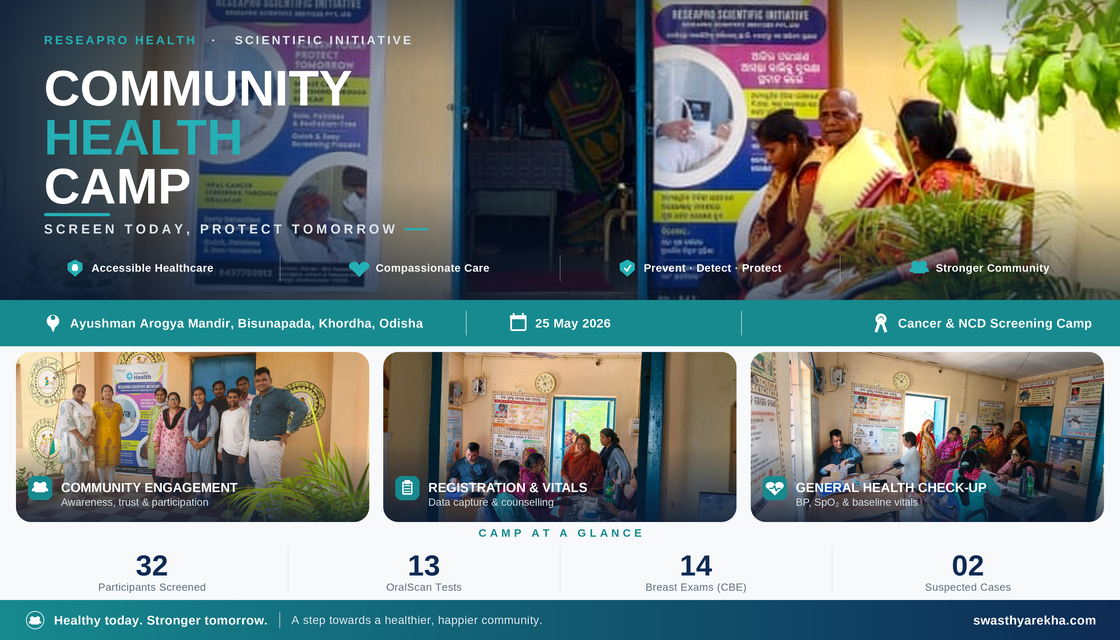
On 25thMay 2026, Swasthyarekha held its sixth community health camp at Ayushman Arogya Mandir, the Government Ayurvedic Hospital in Bisuniapada, Balianta Block, Khordha, in partnership with the facility. Between 8 am and 5 pm, the team registered and screened 32 residents. For every single one of them, the first thing that happened had nothing to do with cancer at all.
Before Any Cancer Screening, Everybody Gets a Full-Body Check
Registration at Bisuniapada looked the way it always does at a Swasthyarekha camp: name, age, contact details, tobacco use, family history, and any symptoms already present, recorded for all 32 participants. What came next, though, is the detail worth sitting with. Height, weight, blood pressure, random blood sugar, oxygen saturation, and heart rate were measured and logged for each of the 32 people in the hall before anyone was screened for oral or breast cancer, and before a single informed consent form was signed for the cancer screening itself.
That ordering is easy to miss and important not to. People generally walk into a “cancer camp” expecting the cancer test to be the main event. At Bisuniapada, the main event for every participant, without exception, was a basic non-communicable disease (NCD) screening, the kind of blood pressure and blood sugar check that catches hypertension and diabetes long before either condition announces itself. The cancer screening that followed was, in a real sense, layered on top of that baseline, not the other way around.
Why Screening Works Better as a Package, Not a Single Test
There is a reason Swasthyarekha treats the NCD check and the cancer check as one visit rather than two separate programmes.
•The risk factors overlap.Tobacco use, alcohol, poor diet, and excess weight raise the odds of oral and breast cancer and of hypertension, diabetes, and heart disease. A single counselling conversation about lifestyle does double duty for both.
•One decision to show up covers everything.Hesitation, not distance, is usually the real barrier to screening. Once someone has agreed to sit for an assessment, the extra few minutes for a blood pressure cuff and a finger-prick sugar test cost far less than organising a second visit to a separate diabetes camp on a separate day.
•No one leaves with nothing.Thirty of the 32 people at Bisuniapada had no suspicious oral or breast finding. Every one of them still left knowing their blood pressure, blood sugar, and BMI - concrete, actionable information rather than a screening visit that turned up empty.
•Comorbidities change what “early” means.A person who is later confirmed to have cancer and also has undiagnosed hypertension or diabetes needs both managed together. Uncontrolled blood pressure or sugar affects fitness for further diagnostic work-up and anaesthesia, as well as the body’s ability to tolerate treatment. Finding that out at the screening stage, rather than after a diagnosis is confirmed, means the referral pathway is a genuinely complete health assessment, not a single-issue test result.
The Numbers from Bisuniapada
All 32 participants had their mouths examined: 19 through a standard visual assessment by trained staff, and 13 through the Oralscan device. Two of the 13 screened by Oralscan returned findings warranting a closer look and have been advised to visit Swasthyarekha's Bhubaneswar centre for confirmatory diagnosis. The remaining 11 were advised to return for rescreening every three months.
Every female participant received breast cancer counselling. 22 underwent a clinical breast examination, and 16 of those also consented to an additional scan at the BR Scan Light Clinic. No suspicious findings turned up in either group. All 22 were advised to seek breast screening at least three times a year and shown how to perform a self-examination in between visits.
What a “Complete Cancer Care Ecosystem” Actually Looks Like on the Ground
Swasthyarekha describes its work as building a complete cancer care ecosystem for India, a network meant to carry a person from community awareness, through screening and confirmatory diagnosis, to treatment navigation and long-term follow-up, rather than leaving them at the point of a single test result. Bisuniapada is a useful, unglamorous illustration of what that actually means on the ground. The ecosystem doesn't start at the oral exam or the breast scan; it starts one table earlier, at the blood pressure cuff. A person whose reading at that table is abnormal enters the same continuity-of-care logic as someone flagged on the Oralscan, a result that needs a next step, a follow-up, and a record that persists after the camp packs up. The ecosystem, in other words, isn't reserved for people who get a suspicious cancer finding. It exists just as much for the person whose only takeaway from the morning is a blood sugar number they didn't have before 8 a.m.
What Happens Next
The two suspected oral cases are the immediate priority, and the follow-up calls to them hadn't gone out yet, which means, as with every camp before this one, the coming weeks matter more than the camp day itself.
Six camps in, across Ganjam, Khordha, Sailashree Vihar, Gadakan, and now a government health centre in Bisuniapada, the pattern holds: the most useful health visit is often the one nobody asked for, checking what's quietly wrong before it has a reason to be checked at all.
Early Detection. Better Care. Healthier Communities.
Reviews & Comments
No reviews yet. Be the first to write one.