

Bringing Early Detection to Bhograi: Swasthyarekha's Community Health Initiative


Bringing Early Detection to Bhograi: Swasthyarekha's Community Health Initiative
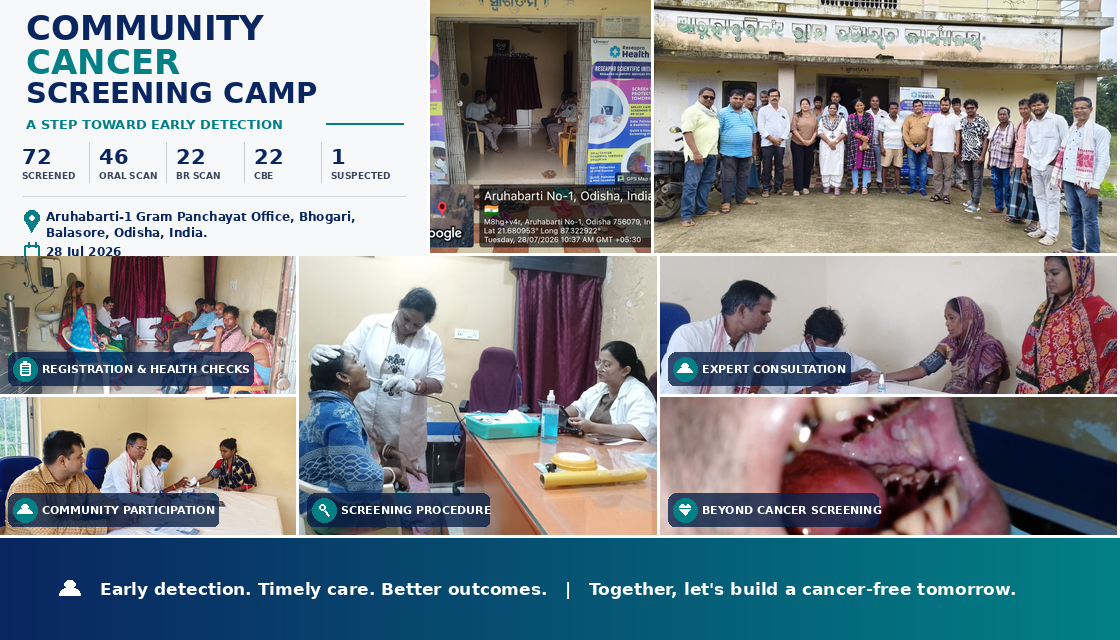
The final day of Swasthyarekha's Balasore outreach began before sunrise and concluded with another community successfully connected to preventive healthcare. On 28 July 2026, the team conducted a Mega Cancer & NCD Screening Camp at the Aruhabrati-I Gram Panchayat Office, Bhograi, Balasore, in association with the Yuva Vikash Foundation, Balasore.
Between 8:00 a.m. and 3:00 p.m., 72 community members received comprehensive health assessments and cancer screening services. For many participants, the camp offered the first opportunity in years to undergo a complete health check close to home without travelling to a distant healthcare facility.
Camp Snapshot
Overall Reach
| Activity | Total |
|---|---|
| Individuals Screened | 72 |
| General Health (NCD) Assessments | 72 |
Oral Cancer Screening
| Activity | Total |
|---|---|
| Oral Visual Assessment | 72 |
| Screened Using oral scan Device | 46 |
| Suspected Oral Cancer Cases | 1 |
Breast Cancer Screening
| Activity | Total |
|---|---|
| Clinical Breast Examination (CBE) | 22 |
| Screened Using BR Scan Device | 22 |
| Suspected Breast Cancer Cases | 0 |
Comprehensive Screening Under One Roof
Every participant who attended the camp first completed registration, during which demographic details, medical history, tobacco and alcohol use, family history, and current health concerns were documented.
Before cancer screening began, all 72 participants underwent a comprehensive Non-Communicable Disease (NCD) assessment, including measurement of blood pressure, blood sugar, height, weight, oxygen saturation, pulse rate, and Body Mass Index (BMI). Written informed consent was obtained before every cancer screening procedure.
By integrating NCD assessment with cancer screening, the camp ensured that participants received a broader picture of their health rather than focusing on a single disease.
Oral Cancer Screening with Advanced Digital Technology
Oral cancer screening formed a major component of the camp. Every participant underwent an oral examination to identify early signs. Including persistent ulcers, white or red patches, abnormal growths, and other suspicious lesions.
A total of 46 participants were screened using the Oral scan device, which digitally captures oral images to support early identification and documentation of abnormalities.
During screening, one participant was identified with a suspicious oral lesion requiring further evaluation. The individual received counselling and was advised to visit the Swasthyarekha centre for confirmatory diagnosis and specialist consultation.
The remaining participants received guidance on maintaining good oral hygiene, avoiding tobacco and alcohol, and returning for routine screening based on their individual risk profiles.
Breast Cancer Screening and Women's Health
Breast cancer awareness counselling was provided to all eligible women attending the camp.
A total of 22 women underwent Clinical Breast Examination (CBE) and all 22 participants also received additional screening using the BR Scan device, enabling a more comprehensive breast health assessment in a safe, comfortable, and radiation-free manner.
No suspected breast abnormalities were identified during screening. Participants were encouraged to continue regular breast screening and were educated on breast self-examination to promote early detection between clinical visits.
Beyond Cancer Screening
The Aruhabrati-I camp demonstrated that community health programmes are most effective when they address overall wellness rather than focusing solely on cancer.
Every participant left with valuable information about their blood pressure, blood sugar, body weight, and other key health indicators. Lifestyle counselling covered tobacco cessation, balanced nutrition, physical activity, oral hygiene, and the importance of periodic health check-ups.
For many residents, this was not simply a cancer screening programme—it was a comprehensive preventive healthcare visit that provided practical guidance for maintaining long-term health.
One Referral, Many Reassured
Among the 72 participants, only one individual required referral for further evaluation after a suspected oral lesion was identified.
This outcome reflects the purpose of community screening programmes: reassuring the majority while ensuring that individuals with suspicious findings receive timely follow-up before disease progresses.
The immediate priority following the camp is support this participant through confirmatory diagnosis and to ensure continuity of care.
Why Community-Based Screening Matters
Hosting the screening camp at the Aruhabrati-I Gram Panchayat Office made preventive healthcare accessible within the community itself. Familiar public spaces encourage greater participation and remove many of the barriers associated with travelling to tertiary healthcare centres.
Such outreach initiatives align with the objectives of the National Programme for Prevention and Control of Non-Communicable Diseases (NPCDCS) by promoting early detection, increasing community awareness, and strengthening preventive healthcare services at the grassroots level.
Looking Ahead
The Aruhabrati-I screening camp marked another important milestone in Swasthyarekha's continuing mission to expand access to cancer screening and preventive healthcare across Odisha.
The next step is ensuring timely follow-up for the participants identified with a suspected oral lesion while continuing to strengthen partnerships with local communities and organizations such as the Yuva Vikash Foundation, Balasore.
Each successful camp reinforces a simple but powerful message: when healthcare reaches the community, early detection becomes possible, timely intervention becomes achievable, and healthier lives become a shared reality.
Early Detection. Better Care. Healthier Communities.
Reviews & Comments
No reviews yet. Be the first to write one.