

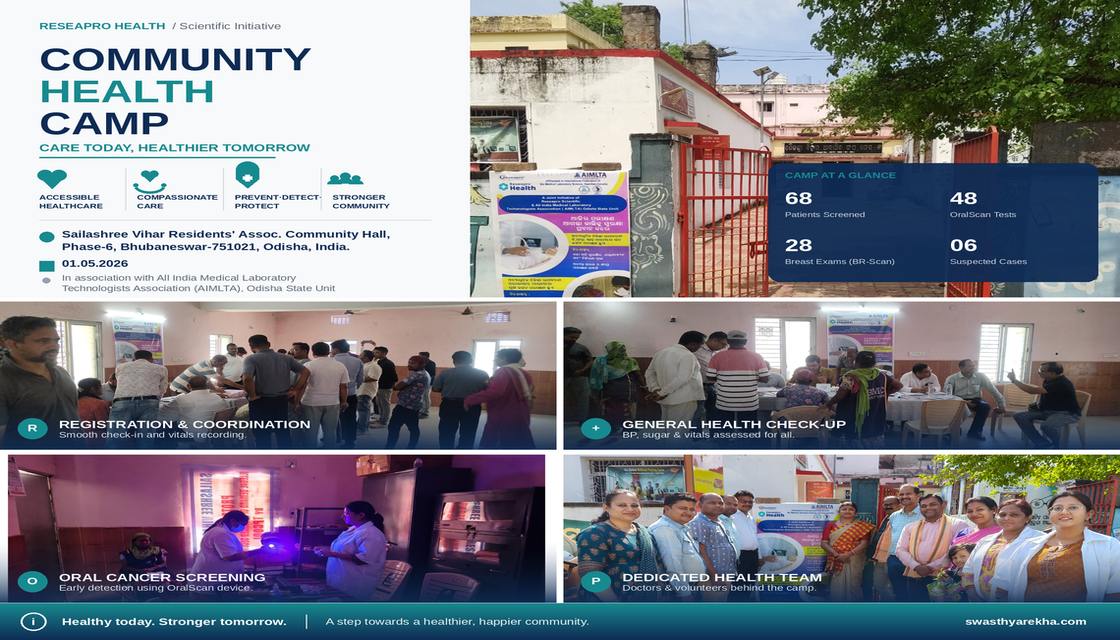
The Devices That Made the Difference: Inside Swasthyarekha’s Fourth Screening Camp


The traditional landscape of cancer diagnostics often feels like a race against time, with the biggest hurdles being distance and testing complexity. On 1st May 2026, Swasthyarekha's 4th health camp at Sailashree Vihar, Bhubaneswar, demonstrated how we are removing these barriers by bringing the laboratory directly to the community hall.
The Science of Non-Invasive Diagnostics
In association with the All India Medical Laboratory Technologists Association (AIMLTA), this camp marked a significant milestone in our mission to standardise cancer screening through innovation.
For both medical professionals and the public, the primary deterrent to regular screening is often the "fear of the procedure". Traditional methods can be invasive, painful, or involve radiation. At Swasthyarekha, we are pivoting to AI-assisted digital technologies that prioritise patient comfort without compromising clinical accuracy.
Meet Oralscan: A Camera That Sees What the Eye Misses
A trained clinician examining the mouth is looking for patches, ulcers, and discolouration that shouldn't be there, and a good clinician catches a great deal. But some tissue changes that precede oral cancer are genuinely difficult to see under ordinary light, especially in a screening setting where the exam has to be quick.
Oralscan works around that limitation. It is a handheld camera that shines light into the oral cavity at several specific wavelengths and reads two signals back: how the tissue reflects that light, and how it fluoresces (tissue that is changing at a cellular level often reflects and fluoresces differently from healthy tissue, even before it looks abnormal to the eye). A machine-learning model, trained on this kind of imaging, scores what it sees and flags anything worth a second look. The whole exchange takes a couple of minutes and leaves behind an image, not just a clinician's memory of what they saw.
At Sailashree Vihar, 48 of the 118 participants were screened this way; the remaining 70 received a standard visual assessment by the team's trained staff, so every single person in the hall had their mouth examined in some form. Of all 118, three showed changes that warrant a closer, confirmatory look and have been advised to visit the Swasthyarekha centre in Bhubaneswar for that follow-up.
Meet BR Scan Light Clinic: A Breast Check Without a Radiology Suite
Breast screening has traditionally meant one of two things: a clinical breast examination by hand, which is useful but subjective, or a mammogram, which needs a fixed machine, a trained radiographer, ionising radiation, and usually a hospital visit.
The BR Scan Light Clinic sits in between. It is a portable, contact-based device that uses light to assess breast tissue for irregularities, without exposing anyone to radiation and without needing anything more than a private corner of a hall and a trained health worker. At this camp, 21 women underwent a clinical breast examination, and 12 of those also received a device-based scan for an added, technology-assisted look. None were flagged as suspicious. It is a result that still matters because every one of the 21 was counselled on repeat screening intervals and shown how to perform a self-examination, so the visit leaves them better equipped even without a finding.
The One Thing Both Devices Insist On: A Completely Dark Room
Neither device runs on ambient light, and that's the whole point. Oralscan measures how tissue fluoresces and reflects at very specific wavelengths of light; the signal is so faint that ordinary room light, or even a stray beam from a window, would wash it out before the sensor could record it. The BR Scan Light Clinic works on a related idea for breast tissue: it reads how light scatters as it passes through, and that pattern only means something if no other light is entering the frame. So while neither device needs an X-ray generator, lead shielding, or a qualified radiographer standing by, both need a room that can be made completely dark, with no other light source, for the reading to be trustworthy.
Why These Two Tools Belong in a Community Hall
For a health professional or a researcher reading this, the interesting question isn't just what these devices found. It's why they're the right instruments for a field camp at all, rather than a compromise version of "real" screening.
- No radiation, no dose limit.Because neither device uses ionising radiation, there's no exposure ceiling to track, no lead shielding to arrange, and no reason to hesitate before recommending repeat screening at a reasonable interval. That matters for a programme built on people coming back.
- Speed that scales.A scan that takes a couple of minutes, rather than a booked slot at a diagnostic centre, is what allows 118 people to be seen in a single working day without anyone waiting for hours.
- Painless and non-invasive.Screening only works if people agree to be screened. A device that requires no needle, no biopsy, and no discomfort removes one more reason for someone to decline, particularly relevant for breast screening, where hesitation is common.
- A digital record instead of a memory.Every Oralscan image is stored. That means a second opinion, a referral, or a comparison against a future visit doesn't depend on a clinician's recollection of what a lesion looked like three months ago. The image itself travels with the patient.
In a City, the Barrier Isn't the Distance
Swasthyarekha's earlier camps were in Ganjam and Khordha, where the nearest cancer facility can be hours away. Sailashree Vihar is inside Bhubaneswar, a short drive from several tertiary hospitals, and 118 people who live there still hadn't been screened. That's worth sitting with. In a city, the barrier is rarely distance; it's the appointment nobody booked, the half-day nobody could take off, or simply never having been asked. A camp that sets up in the hall where a residents' association already meets removes exactly that friction. Screening arrives at a place people already trust, on a day they were already free.
What Happens Next
The three suspected oral cases are the immediate priority. Each participant has been advised to visit the Bhubaneswar centre for a confirmatory diagnostic work-up, and following through on that referral is the actual measure of success from this camp, more than the headline number of 118. Everyone else was counselled individually: on tobacco cessation, where relevant; on a screening interval suited to their risk; and, for the women screened, on self-examination and when to come back.
Our thanks go to the All India Medical Laboratory Technologists Association and the Sailashree Vihar Residents' Association for making the hall, and the morning, available. If you represent a hospital, diagnostic centre, professional association, NGO, corporate CSR team, or government body interested in bringing a screening camp to your community, or you'd like to be screened at the next one, we'd like to hear from you.
Early Detection. Better Care. Healthier Communities.
Reviews & Comments
No reviews yet. Be the first to write one.