

The Camp With Zero Suspected: Inside Swasthyarekha's Eighth Screening Camp at Jharapada


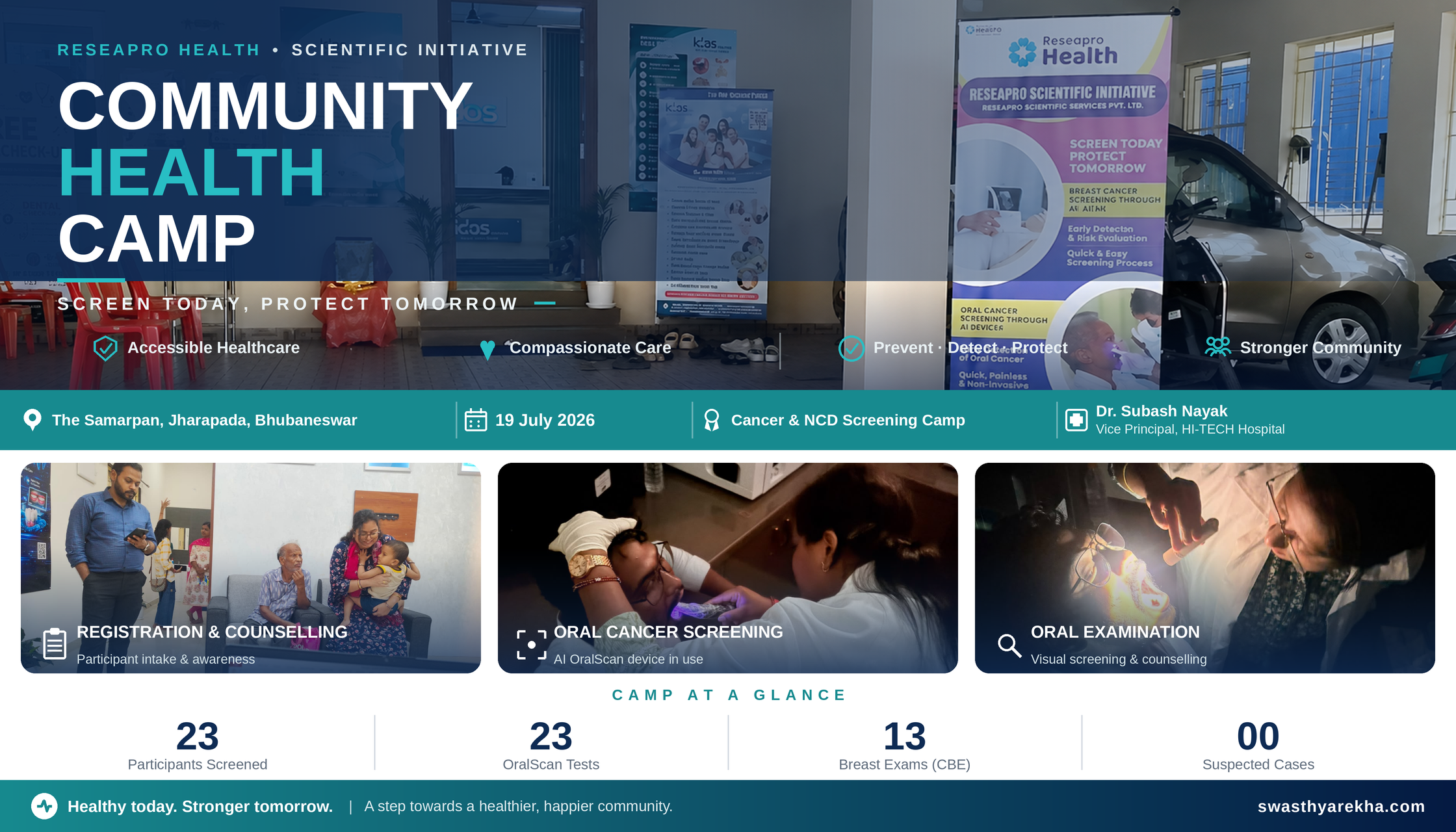
Every Swasthyarekha camp opens with the same unspoken question: what will the day find? At The Samarpan in Jharapada, Bhubaneswar, the eighth community screening camp under the Swasthyarekha initiative, held on 19 July 2026 in association with HI-TECH Hospital, answered that question differently from every camp before it. Of the 23 residents who came forward for oral and breast cancer screening, none required a referral. For a programme built on catching disease before it announces itself, a day that finds nothing to catch isn't a quiet anticlimax - it's precisely what the model is supposed to deliver some of the time, and it's worth explaining why that matters just as much as a camp that flags four cases.
Camp 8 at a Glance
| Metric | Count |
|---|---|
| Total Residents Screened | 23 |
| General Health (NCD) Assessments | 23 |
| Oral Visual Assessment (OVA) | 23 |
| Oralscan Device Screening | 23 |
| Suspected Oral Cancer Cases | 0 |
| Clinical Breast Examination (CBE) | 13 |
| BR Scan Device Screening | 13 |
| Suspected Breast Cancer Cases | 0 |
A Health Check Before the Cancer Check
As at every Swasthyarekha camp, the morning began with a form rather than a device. All 23 participants were registered: name, age, contact details, tobacco use, family history, and any symptoms already present, with this information recorded before anything else. Height, weight, blood pressure, random blood sugar, oxygen saturation, and heart rate were then measured and logged for each of the 23 participants, turning The Samarpan's community space into a working health-check point for hypertension, diabetes, and cardiovascular risk, well before anyone was screened for cancer. No participant proceeded to the oral or breast examination without first reading and signing an informed consent form.
Awareness, Before Any Device Came Out
A short, plain-language session followed registration and covered the most important risk factors: tobacco and alcohol use, poor oral hygiene, and lifestyle habits, as well as the early warning signs of oral and breast cancer. A hands-on demonstration of correct oral hygiene practices rounded off the session, so that by the time any participant sat down for a screening, they already understood what the team was looking for and why.
Oral Cancer Screening: Twenty-Three Examined, Zero Flagged
Every one of the 23 participants underwent an oral visual assessment (OVA): lips, tongue, cheeks, gums, and throat were checked for white or red patches, ulcers, and other lesions that can precede oral cancer. All 23 were also screened using the Oralscan device, which records each examination digitally rather than relying on a clinician's memory of what was seen. No participant returned a finding that warranted referral. Everyone was still encouraged to return for periodic rescreening and to raise awareness of oral cancer screening among family and friends - a clear result is a data point, not a reason to stop checking.
Breast Cancer Screening: Thirteen Examined, Thirteen Clear
All female participants received breast cancer counselling, and 13 went on to undergo a Clinical Breast Examination (CBE), with the same 13 also screened using the BR Scan device. All 13 were found to be normal. As with the oral results, a normal finding was accompanied by the same advice given to every participant, regardless of outcome: screen again at least three times a year, and know how to perform a self-examination between visits.
Why "Nothing Found" Is Still a Result Worth Recording
Before this one, Swasthyarekha had flagged at least one suspected case at each of the seven camps - a reminder of how much undetected disease remains in communities that have never had the chance to be screened. Jharapada breaks that streak, and it would be a mistake to read that as the streak mattering less than the number.
A screening programme that finds something every single time would be cause for concern. It would suggest camps are only reaching people after disease has already taken hold widely enough to guarantee a positive finding. Zero suspected cases out of 23 is a perfectly plausible outcome in an early-screened community, and it doesn't retroactively make the morning unnecessary. It simply means the value of the visit lay elsewhere: in blood pressure and blood sugar numbers now on record, in a self-examination technique now known, in a screening interval now understood, all of it in place before anyone had a reason to go looking for it.
For 23 residents at The Samarpan, that means walking away not with nothing, but with a documented health baseline, a screening habit, and a known date to return for the next one: at exactly the point in the process when prevention still works better than any treatment that might follow.
Eight Camps In, and Counting
With Jharapada added to Ganjam, Khordha, Sailashree Vihar, Gadakan, Bisuniapada, and Puri, Swasthyarekha's eighth camp continues the shift towards Bhubaneswar's residential communities. It proves that the distance early detection has to travel isn't always measured in kilometres. Sometimes it's just the walk from a flat to the community hall downstairs.
Our thanks go to Dr. Subash Nayak, Vice Principal of HI-TECH Hospital, for partnering in this camp, to the residents and management of The Samarpan, and to every participant who set aside a morning for examination. If you represent a hospital, diagnostic centre, NGO, corporate CSR team, residents' welfare association, or government body interested in bringing a screening camp to your community, or would simply like to be screened at the next one, we'd love to hear from you.
Early Detection. Better Care. Healthier Communities.
#Health#India#Odisha#Bhubaneswar#Jharapada
Reviews & Comments
No reviews yet. Be the first to write one.