

Reaching the Heart of Puri: Swasthyarekha’s 7th Screening Camp Rolls Into Nimapada


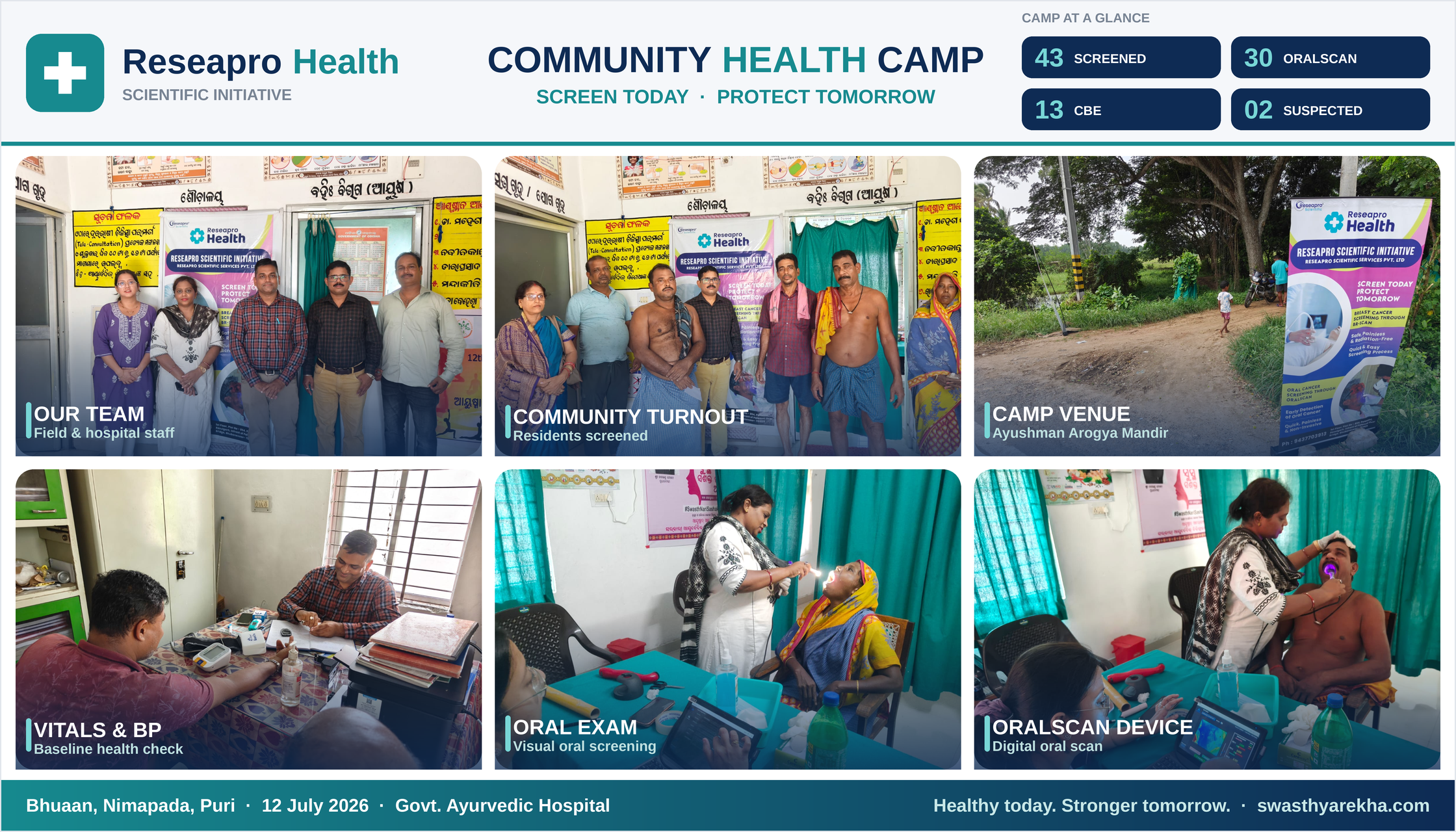
Puri is a name most people associate with a temple town and a coastline, not with the villages an hour or two inland, accessible only via roads that narrow the further you go. That is where Swasthyarekha headed on July 12, 2026: not towards the pilgrims and the sea, but towards Bhuina, a village near Nimapara, for the programme’s seventh community screening camp and its first stop in Puri district. State Project Coordinator Debasish Das, Research Associate T. Sujata, and Medical Officer Bishakha Panda made the trip, carrying two portable devices, a stack of consent forms, and the same question that has driven six camps before this one: what happens to early cancer detection when it stops waiting for people to come looking for it and starts going to them instead?
Seven O’Clock in Bhuina: A Hospital Opens Its Doors Wider
The team arrived at a government facility already quietly treating the sick, and for one day helped it take on a second, complementary job: finding disease before it has a reason to be found. The team worked from 7 a.m to 3:30 p.m, a longer day than most Swasthyarekha camps, the kind of stretch a first visit to a new district tends to demand. By the time the last participant walked out, 43 residents of Bhuina and the villages around Nimapara had been screened at the doorstep, without a single one needing to travel to a diagnostic centre in Bhubaneswar or Cuttack for an examination.
This, in miniature, is what “bridging the gap” looks like in practice. Not a single grand intervention, but a team willing to drive further and a rural government hospital willing to lend its rooms for a morning, so that people who might otherwise never reach a specialised cancer centre don’t have to travel at all.
Before Any Cancer Test, a Full-Body Health Check
As at every Swasthyarekha camp, the day began with a form, not a scan. All 43 participants were registered. Before anyone signed a consent form for cancer screening, each participant had their height, weight, blood pressure, random blood sugar, oxygen saturation, and heart rate checked and recorded. For a morning billed as a cancer camp, the first patient in every chair was really hypertension, diabetes, and cardiovascular risk: a baseline non-communicable disease (NCD) screening layered beneath the cancer screening people had actually come for. Only once that was done, and only once every participant had read and signed an informed consent form explaining exactly what the procedure involved, did the day move on to the oral and breast examinations.
A Talk Before the Test
Before any device was used, the group sat through a short, plain-language session on factors that quietly raise cancer risk, such as tobacco, alcohol, poor oral hygiene, and lifestyle patterns, and on what early breast and oral cancers can look and feel like, alongside a hands-on demonstration of oral hygiene practices. It is tempting to treat this as the warm-up act before the “real” screening. For a programme that measures success by whether people return every few months rather than by a single visit, the conversation arguably does as much long-term work as any scan that follows it.
In the Oral Cancer Queue
Every one of the 43 participants had their mouth examined. Thirteen underwent a standard visual assessment, with their lips, tongue, cheeks, gums, and throat checked by trained staff for white or red patches, ulcers, and other lesions that can precede oral cancer. The remaining thirty went a step further, being screened with the Oralscan device, which reads how oral tissue reflects and fluoresces under specific wavelengths of light to flag the kind of early cellular change that a quick visual pass alone can miss.
2 of those 30 returned with findings warranting a closer look and were advised to visit Swasthyarekha’s Bhubaneswar centre for confirmatory diagnosis. The other 28, along with the thirteen assessed visually, were advised to return for rescreening every three months, not because anything is wrong, but because that is precisely the interval at which any issue would still be caught early.
In the Breast Cancer Queue
Every woman at the camp received breast cancer counselling. 13 agreed to a Clinical Breast Examination, and all 13 also consented to an additional scan at the BR Scan Light Clinic. Nobody was flagged as suspicious. Each of the 13 was still advised to seek breast screening at least three times a year and shown how to perform a self-examination between visits, so the morning paid off even for those who left with a clear result.
A Doctor’s Endorsement, and a Ripple That Might Outlast the Camp
Dr. Mahesh Kumar Nanda, the hospital’s in-charge, was briefed on Swasthyarekha’s broader cancer care ecosystem. The idea is that a person’s journey doesn’t end with a screening result but continues through confirmatory diagnosis, treatment navigation, and long-term follow-up. He appreciated the initiative and offered his support, including sharing photographs and videos of the camp with the Director of AYUSH, Government of Odisha, and circulating them within his professional network. He also expects several of his colleagues at other facilities to be interested in hosting similar camps.
That is the quieter half of bridging the gap between rural communities and early cancer diagnosis. A single camp screens 43 people. A hospital in charge who picks up the phone to his own network of colleagues has the potential to set up a screening table in front of many more, in places Swasthyarekha hasn’t reached yet.
Seven Camps In: Why Puri Changes the Map
Ganjam, Khordha, Sailashree Vihar, Gadakan, Bisuniapada, and now Bhuina, Nimapara, in Puri. Seven camps in, Swasthyarekha’s screening map has grown from two to three districts, and the underlying pattern hasn’t changed: healthcare that goes to the person, rather than waiting for the person to find their way to a hospital, catches things earlier. For a family in rural Puri, that earlier catch is rarely just a clinical detail. It is often the difference between a short, local course of treatment and a long, costly one that involves travel, lost income, and the kind of debt that out-of-pocket cancer care can push a household into. Bridging that gap, one district and one doorstep at a time, is the whole point of the drive.
Early Detection. Better Care. Healthier Communities.
Reviews & Comments
No reviews yet. Be the first to write one.