

Empowering Rural Health: Swasthyarekha’s Mission for Early Detection Reaches Soran


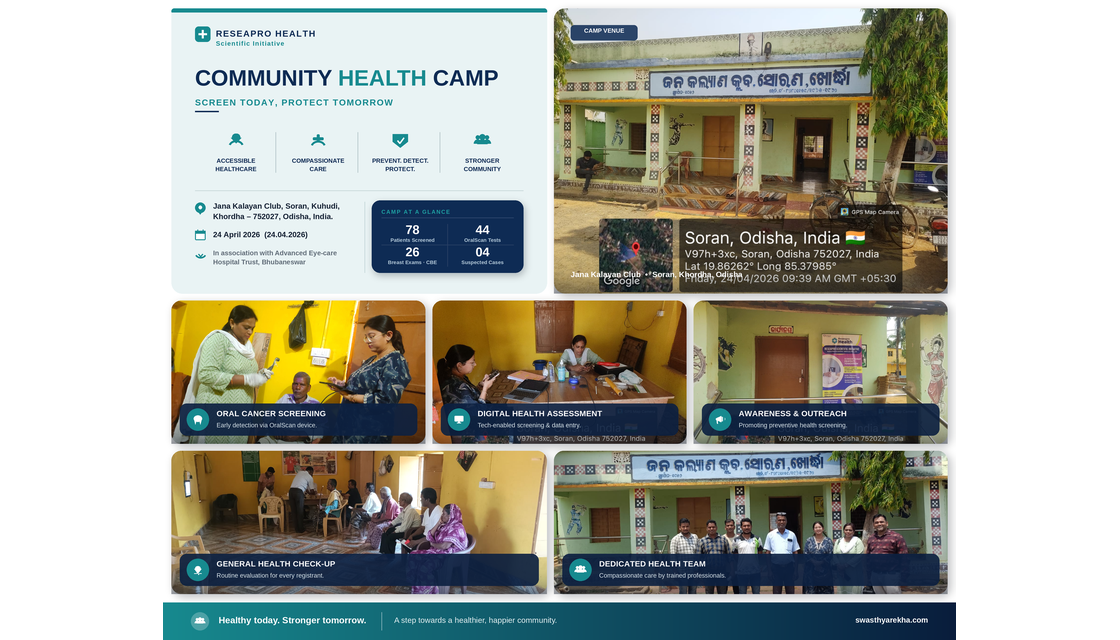
On April 24, 2026, the Swasthyarekha team, in collaboration with the Advanced Eye-care Hospital Trust, Bhubaneswar, successfully held its third major cancer screening camp. The outreach initiative took place at the Jana Kalayan Club in Soran, Khordha, bringing advanced diagnostic services to a community with limited access to specialised medical facilities.
About This Camp
- Date & Time:24 April 2026, 8:30 a.m. to 5:00 p.m.
- Venue:Jana Kalyan Club, Soran, Kuhudi, Khordha – 752027, Odisha
- Organised By:Reseapro Health, under the Swasthyarekha community screening initiative
- In Association With:Advanced Eye-care Hospital Trust, Bhubaneswar
- Conducted By:Mr. Debasish Das (State Project Coordinator), Ms. T. Sujata (Research Associate), and Ms. Bishakha Panda (Medical Officer)
The Camp at a Glance
- 78 people screened
- 78 general health (NCD) assessments
- 78 oral examinations: 34 by visual assessment, 44 using the Oralscan device
- 4 suspected oral cancer cases identified
- 26 clinical breast examinations, 0 suspected cases
A Proactive Approach to Community Wellness
The day began early, with our dedicated team departing at 5:30 AM to ensure the camp was ready for the community by morning. The primary objective was clear: to bridge the gap between rural populations and early cancer diagnosis, thereby facilitating a journey from awareness to recovery.The camp recorded notable attendance, with 78 participants undergoing comprehensive health screenings. All of them began at the registration table, where they provided their name, age, contact details, and a brief medical history covering tobacco use and family history. The team also conducted a general non-communicable disease check for each person: height, weight, blood pressure, random blood sugar, oxygen saturation, and heart rate. No one left with only cancer screening results; everyone had a basic idea of their health status, and a signed consent form was collected before any screening procedure began.
Awareness and Education
For Swasthyarekha, a health camp is more than a diagnostic event; it is an educational platform. Before the devices were unveiled, there was a brief, plain-language discussion on oral hygiene practices and early cancer symptoms. This covered risk factors, such as tobacco, alcohol, poor oral hygiene, and general lifestyle, and the early signs of oral and breast cancer. The team also walked participants through correct oral hygiene practices and emphasised the cessation of tobacco and alcohol, which remain high-risk factors for oral malignancies.
Oral Screenings
The mouth, tongue, cheeks, gums, and throat of every participant were examined for patches, ulcers, and other changes that are often seen in oral cancer. 34 participants were assessed visually; the remaining 44 were screened with the Oralscan device, which stores each examination digitally rather than relying on a verbal observation. Four of those 44 showed lesions that warranted a closer look. They were advised to call the centre directly and come to Bhubaneswar for a confirmatory diagnostic work-up. The other 40 were advised to return for a repeat screening every three months.
Breast Cancer Screening
Counselling on breast cancer screening was offered to every woman at the camp. 26 chose to go ahead, signed consent, and underwent a clinical breast examination. All 26 were found to be normal, and each was advised to repeat the screening three times a year going forward.
A Way to Reach Back
Individual counselling was provided based on each person’s unique test result: tobacco cessation for some, while others received generic lifestyle counselling, but everyone was informed about why these four cases had to be investigated further. Pamphlets on cancer awareness, prevention, and locally available health services went home with participants and their families, so the day's message didn't stop at the club's front door.
Why a Community Club, and Why It Works
Soran doesn't have its own hospital, and a resident here isn't going to travel to Bhubaneswar on the off chance that something might be wrong. That is the entire logic behind holding a screening camp at a Jana Kalyan Club rather than asking people to come to us: it is a building where people already gather, trust, and can reach on foot. The elimination of distance removes the single most important reason early screenings don’t happen in small towns and villages of Odisha, and the National Programme for Prevention and Control of Non-Communicable Diseases (NPCDCS) aims to fill this gap with such screenings. India adds an estimated 1.46 million new cancer cases a year, and oral and breast cancers sit among those most reliably caught early, provided someone actually gets the chance to be looked at.
The Path Forward
Early detection is not just a medical goal; it is a societal necessity that reduces treatment costs and, ultimately, saves lives. By utilising non-invasive, AI-enabled technology such as Oralscan in field settings, we will be able to detect abnormalities in their precancerous stage, when treatment success rates are highest.The next step after Soran is straightforward: follow up with the four participants flagged for suspected oral lesions, so that identification at the club hall translates into an actual diagnosis at our centre, not just remain as names on a list.
Be Part of the Next Camp
Our thanks go to the Advanced Eye-care Hospital Trust, Bhubaneswar, the Jana Kalyan Club, Soran, and every participant who walked in and sat down for examination. If you represent a hospital, diagnostic centre, NGO, corporate CSR team, or government body interested in bringing a screening camp to your community, or you'd simply like to be screened at our next one, we'd like to hear from you.
Early Detection. Better Care. Healthier Communities.
Reviews & Comments
No reviews yet. Be the first to write one.