

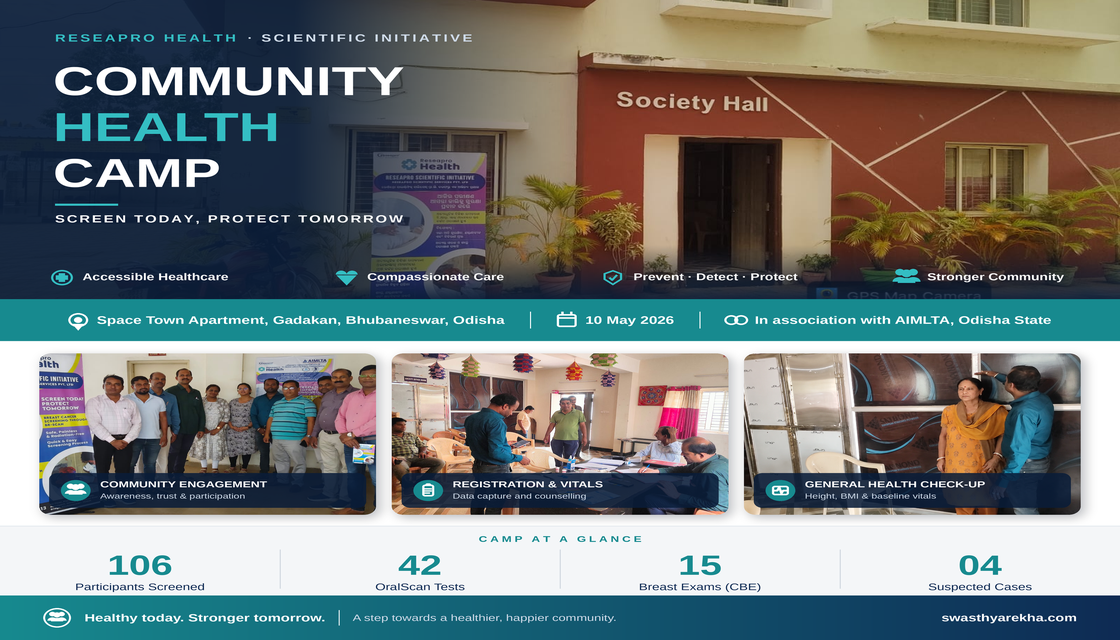
Before the Diagnosis: Inside Swasthyarekha's Fifth Screening Camp at Gadakan


On May 10, 2026, Swasthyarekha held its fifth community screening camp at Space Town Apartment in Gadakan, Bhubaneswar, in partnership with the All India Medical Laboratory Technologists Association (AIMLTA). Between 8:30 am and 3 pm, 106 residents walked into their own society hall and did something an average healthcare visit never asks of a person: they showed up before anything felt wrong.
The Difference Between Sick Care and Health Care
Most people's relationship with the healthcare system begins with a complaint. A lump is noticed, a sore takes too long to heal, a cough won't go away, and only then does anyone book an appointment. It is a perfectly reasonable way to live, right up until the day it isn't, because cancer is one of the few conditions in which the gap between “something feels off” and “this is now advanced” can be measured in months, not years.
Swasthyarekha's camps are based on a different notion: the best time to detect cancer is precisely when nobody suspects it. A patch on the inner cheek or a change in breast tissue detected while a person still feels completely well is, in almost every clinical sense, a different disease from the same finding detected a year later, after it has announced itself through pain, a palpable mass, or spread beyond its original site. Earlier-stage disease is generally easier to treat, more amenable to local rather than systemic treatment, and gives people meaningfully better odds of coming through it.
8:30 AM: The Paperwork of Prevention
The morning began the way every camp does, not with a scan but with a form. Swasthyarekha's team, comprising State Project Coordinator Debasish Das, Research Associate T. Sujata, and Medical Officer Bishakha Panda, documented all 106 participants, recording their names, ages, contact details, tobacco use, family history, and any symptoms already present. Each participant’s height, weight, blood pressure, random blood sugar, oxygen saturation, and heart rate were recorded, turning a residents' hall into a working baseline health check for hypertension, diabetes, and cardiovascular risk, alongside the cancer screening that was the day's main purpose. Nobody was screened for anything, cancer included, until they had read and signed an informed consent form explaining exactly what the procedure involved.
A Talk Before the Test
Before any device was used, the group sat through a short, plain-language session explaining why any of this mattered: how tobacco, alcohol, poor oral hygiene, and certain lifestyle patterns raise cancer risk; what early breast and oral cancers can look and feel like; and why a screening interval matters more than a single visit. A hands-on demonstration of oral hygiene practices followed. It is easy to treat the awareness talk as the warm-up act before the main screening, but for a programme built on people returning every few months, the talk arguably does more long-term work than any single scan.
In the Oral Cancer Queue
Every one of the 106 participants had their mouth examined. 64 underwent a standard visual assessment, with their lips, tongue, cheeks, gums, and throat checked by trained staff for patches, ulcers, and discolouration that can precede oral cancer. The remaining 42 went a step further, being screened using the Oralscan device, which reads how oral tissue reflects and fluoresces under specific wavelengths of light to flag cellular changes that can be genuinely difficult to catch on a quick visual pass alone.
Three of those forty-two came back with findings worth a closer look and have been advised to visit Swasthyarekha's Bhubaneswar centre for confirmatory diagnosis. The other thirty-nine were advised to return for rescreening every three months, not because anything is wrong, but because that is precisely the interval at which something wrong would still be caught early.
In the Breast Cancer Queue
Every female participant received breast cancer counselling. 28 agreed to a clinical breast examination, and 15 of them went further still, consenting to an additional device-based scan using the BR Scan Light Clinic. One abnormality was detected among those screened; everyone else was found to be normal. Every one of the 28, regardless of outcome, was advised to seek breast screening at least three times a year and shown how to perform a self-examination in between visits.
What Early Really Buys a Family in Odisha
It's worth sitting with what those four flagged cases actually represent, because the number itself, 4 out of 106, is not really the point. The point is what stage of disease those four people now have the chance to be treated at, versus the stage they might have reached had nobody looked until they noticed something themselves.
For a family in Odisha, that difference is rarely just clinical. A lesion detected while still localised often means a shorter, less invasive course of treatment, closer to home, and a faster return to work. The same finding, left until it causes pain or becomes visible, more often means travel to a tertiary centre, a longer and costlier treatment course, and months of lost income for whoever in the family takes on the role of caregiver, a role that, in most Indian households, still falls disproportionately on women. Out-of-pocket cancer treatment is one of the most reliable ways an Indian family slides into debt or sells an asset it can't easily replace. None of that is certain for any of the four people flagged at Gadakan. But screening exists precisely to keep it that way, an open question rather than an inevitability.
By 3 PM: Four People, One Next Step
The camp wrapped up at 3 in the afternoon, having produced its most important output: not the tally of 106 screened, but a short list of four people who now know something they didn't know that morning, and a plan for what to do about it. As of this report, the follow-up calls to those four participants hadn't yet gone out, which makes the coming weeks, not the camp day itself, the real test of whether this exercise succeeds. Confirmatory diagnosis and, where needed, treatment initiation are the parts of the process that determine whether early detection here translates into early treatment.
Everyone else left with something, too: pamphlets on cancer awareness, prevention, and locally available health services, and a personal sense of where they stand on tobacco use, screening intervals, and self-examination that they didn't have when they walked in.
Before Illness, Not After
Five camps in, the pattern across Ganjam, Khordha, Sailashree Vihar, and now Gadakan is the same: healthcare that shows up before someone has a reason to seek it out finds things earlier, and earlier is almost always better for the person and for the family absorbing the cost of whatever comes next.
Early Detection. Better Care. Healthier Communities.
Reviews & Comments
No reviews yet. Be the first to write one.